Global demand for compact, efficient power electronics is reshaping magnet-wire selection. MarketsandMarkets’ Magnet Wire Market report links market growth to electric vehicles, renewable-energy equipment, transformers, and industrial motors. These applications need controlled insulation, lower AC losses, and reliable thermal performance. Litz Ustc Wire addresses these demands through many individually insulated strands, reducing skin and proximity effects at higher frequencies.
The right construction still depends on frequency, current, voltage, winding space, and thermal class. A thin-strand design may improve flexibility, but it can increase manufacturing complexity and termination risk. A larger strand may simplify handling, yet it can raise high-frequency losses. Small details matter. Think of a transformer winding packed into a narrow bobbin, where every millimeter affects heat flow and electrical clearance.
Grand View Research reports continued expansion in electric wire and cable demand, driven by electrification and infrastructure investment. Its findings support a broader purchasing trend, but they do not identify one universal Litz specification. That limitation deserves attention. Global buyers should compare supplier test data, IEC 60317 requirements, insulation systems, bonding methods, and traceability records before choosing a type.
This guide reviews ten Litz USTC wire types for practical international sourcing. It considers strand diameter, strand count, insulation, self-bonding behavior, temperature capability, and application fit. Some recommendations may appear straightforward. They are not always so. A datasheet can look excellent while winding trials reveal poor flexibility, uneven bonding, or difficult stripping. Experienced buyers therefore validate samples under real operating conditions, not only through catalog figures.
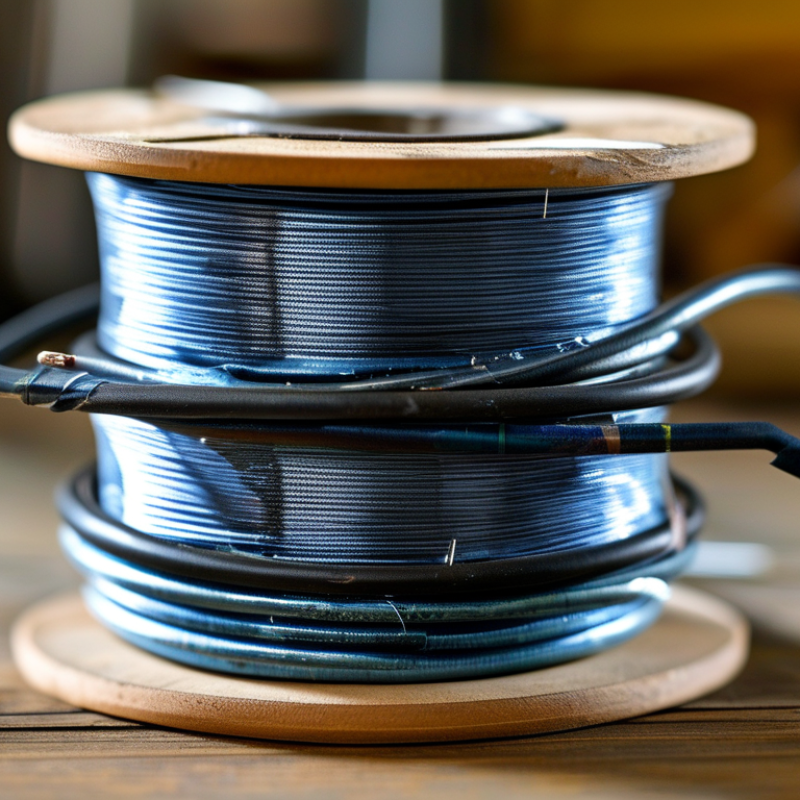
Litz USTC wire combines many fine copper strands into one flexible conductor. Each strand carries enamel insulation, reducing proximity and skin-effect losses at higher frequencies. The strands are twisted in a controlled pattern, then covered with an outer wrap or bonding layer. Under magnification, the cross-section should look even, not crowded or irregular.
USTC is commonly used as a construction code, but its meaning can vary between suppliers. A reliable name should identify strand count, single-strand diameter, twisting method, insulation type, outer size, and temperature class. Some specifications also include voltage rating and bonding requirements. The label alone is not enough. Buyers should compare it with a drawing, sample, and test report. In practice, naming systems are not perfectly universal, which can create avoidable mistakes.
Tips: Ask for the complete construction code, not only “USTC wire.” Check conductor resistance at the stated temperature. Inspect flexibility after repeated bending. Confirm the operating frequency and winding space before approval. A small mismatch in strand diameter can affect fill factor and heat behavior. It is also wise to review tolerance limits, because an attractive nominal value may hide large production variation.
| Rank | Typical USTC Configuration | Strand Diameter | Strand Count | Approx. Copper Area | Typical Finished Diameter | Common Structure | Typical Enamel Class | Typical Applications |
|---|---|---|---|---|---|---|---|---|
| 1 | 0.025 × 120 | 0.025 mm | 120 | 0.059 mm² | Approx. 1.2–1.8 mm | Ultra-fine enamelled strands with textile serving | 155–180 °C | High-frequency transformers, compact wireless-power coils |
| 2 | 0.032 × 100 | 0.032 mm | 100 | 0.080 mm² | Approx. 1.4–2.0 mm | Fine Litz bundle with polyester or nylon serving | 155–180 °C | Switch-mode power supplies, resonant converters |
| 3 | 0.040 × 100 | 0.040 mm | 100 | 0.126 mm² | Approx. 1.7–2.4 mm | Enamelled copper strands, twisted and served | 155–200 °C | Inductive chargers, ferrite-core transformers |
| 4 | 0.050 × 100 | 0.050 mm | 100 | 0.196 mm² | Approx. 2.0–2.8 mm | Standard multi-strand Litz with braided textile covering | 155–180 °C | Medium-frequency transformers, induction heating coils |
| 5 | 0.071 × 80 | 0.071 mm | 80 | 0.317 mm² | Approx. 2.4–3.3 mm | Round twisted bundle with enamel insulation and serving | 155–200 °C | Power inductors, welding transformers, resonant tanks |
| 6 | 0.080 × 100 | 0.080 mm | 100 | 0.503 mm² | Approx. 2.9–4.0 mm | High-fill-factor Litz bundle, served or film wrapped | 155–180 °C | High-current converters, EV auxiliary transformers |
| 7 | 0.100 × 100 | 0.100 mm | 100 | 0.785 mm² | Approx. 3.4–4.6 mm | Enamelled copper Litz core with polyester, nylon, or silk serving | 155–200 °C | High-frequency transformers, induction power systems |
| 8 | 0.120 × 80 | 0.120 mm | 80 | 0.905 mm² | Approx. 3.8–5.1 mm | Robust twisted Litz bundle with protective textile serving | 155–180 °C | Power electronics, medium-frequency magnetic components |
| 9 | 0.150 × 80 | 0.150 mm | 80 | 1.414 mm² | Approx. 4.5–6.0 mm | Large-current Litz core with abrasion-resistant serving | 155–200 °C | Traction inverters, industrial resonant equipment |
| 10 | 0.200 × 60 | 0.200 mm | 60 | 1.885 mm² | Approx. 5.0–6.8 mm | Heavy-duty Litz bundle with textile or polymeric protection | 155–180 °C | High-power transformers, induction heaters, inverter bus connections |
USTC may describe different constructions across suppliers. Request a drawing, not only a catalogue label.
Finer strands can reduce high-frequency AC losses. They may also cost more and resist handling damage less.
Round wire offers balanced conductivity and simple winding. High-strand-count designs bend smoothly around small bobbins.Rectangular wire improves slot filling and heat transfer. However, its edges can suffer damage during winding.
Self-bonding wire helps coils retain their shape after heat or solvent activation.That stability matters.Check activation conditions carefully. A bonding layer may increase the outer diameter and reduce flexibility.
Compare the insulation temperature class with the coil’s actual operating temperature.Common classes include 155°C, 180°C, and 200°C. Higher ratings add design margin but usually cost more.Cold-room resistance readings can mislead. Measure resistance near the working temperature.
Request strand diameter, strand count, twisting pitch, insulation material, and finished outer diameter.Also request dielectric strength, thermal data, solderability, and test conditions. Missing conditions weaken the comparison.Paperwork is not enough.
Order samples from the intended production line. Measure outer diameter at several points.Inspect loose strands under magnification. Check bend radius, resistance, insulation continuity, and winding behavior.A small variation can disrupt automated winding. I would not dismiss it again.
Include strand size, covering layers, bonding coating, terminal stripping, and spool length.Add operating frequency, current, temperature, bend radius, and dimensional tolerances. State the required finished-coil size.Vague drawings create avoidable arguments.
Measure the completed coil, not only the loose wire. Check current density, resistance, dielectric withstand, bend radius, and fill factor.Compare results with the intended operating temperature. Perfect evidence is rare, but controlled verification is practical.
This guide introduces Litz Ustc Wire by explaining its basic construction, insulation layers, strand arrangement, and naming principles. It presents ten representative wire types classified by strand count, conductor size, insulation system, twisting pattern, temperature capability, and intended operating frequency. For each type, readers can compare key electrical and mechanical features, including resistance, current handling, flexibility, dielectric performance, thermal endurance, winding efficiency, and resistance to abrasion or repeated bending.
The article also offers a practical selection framework for global buyers. It explains how to match Litz Ustc Wire with frequency range, voltage level, winding space, thermal conditions, and equipment requirements. In addition, it highlights the importance of checking international standards, test documentation, tolerances, packaging, traceability, and customization capabilities. Careful supplier evaluation and clear technical communication can help buyers obtain consistent quality, reliable delivery, and a wire design suited to their application.

 Lucky Pioneer